Postiz vs Zernio starts with an odd pair of numbers. Connect two social accounts and Zernio charges you $0. Postiz Cloud charges $29 a month, because it has no free cloud plan at all.
Push to 30 accounts and the bill flips: $108 a month on Zernio against $49 on Postiz Cloud.
So this isn't a feature fight. It's about how you want to be billed, and who keeps the thing running. Several comparisons also get one detail about Zernio wrong, and that detail changes who it's for.
I use Zernio through Grok Bot, my AI assistant, with two accounts connected, and it hasn't cost me anything so far. I haven't used Postiz, so its side comes from Postiz's pricing page, docs and GitHub repo.
Some links here are affiliate links. They don't change your price or my verdict.
Postiz vs Zernio at a glance
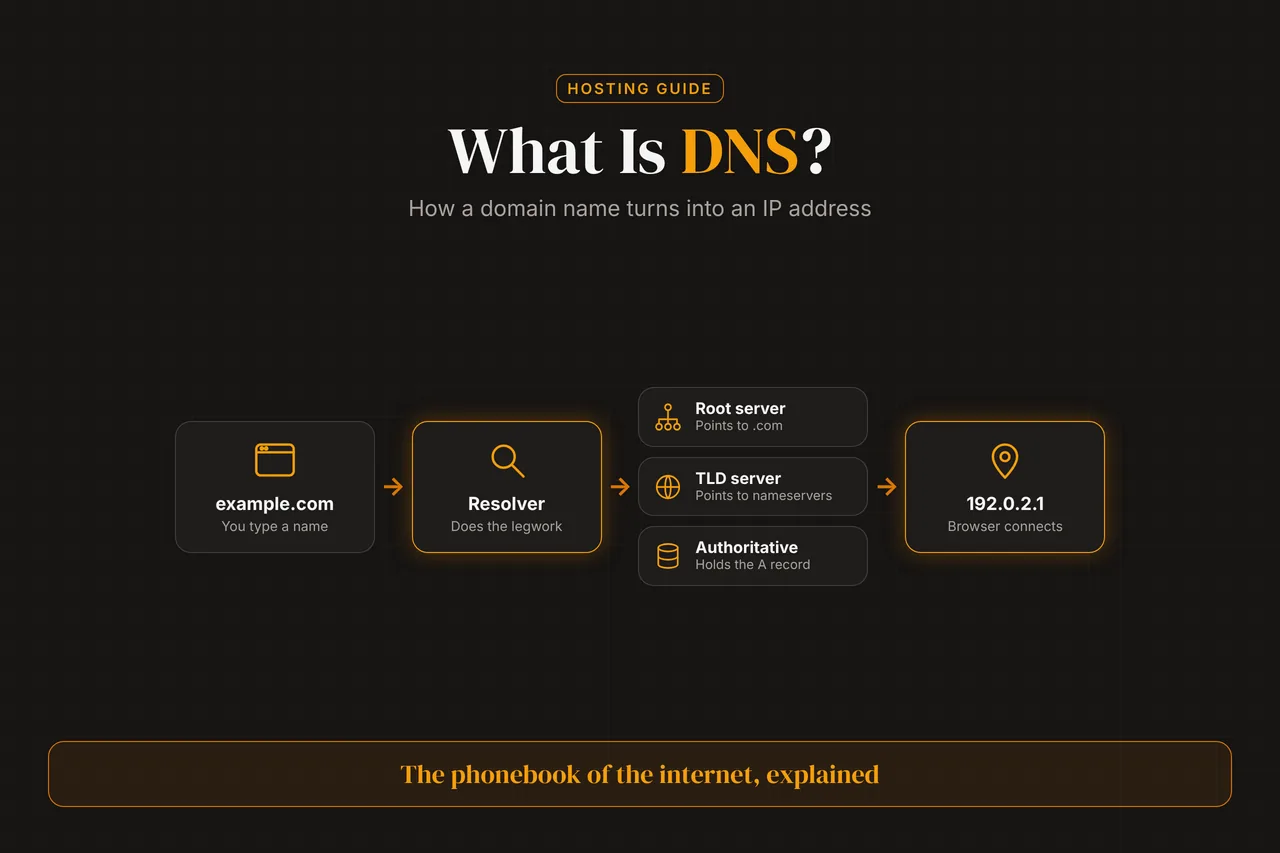
Postiz is an open-source social media scheduler you can self-host for free or rent as Postiz Cloud. Zernio is a hosted social media API with a dashboard and an MCP server on top, called Late until a rebrand. If "API" feels fuzzy, here's what an API does in plain English.
| Postiz | Zernio | |
|---|---|---|
| What it is | Open-source scheduling app, cloud or self-hosted | Hosted social media API, dashboard and MCP server |
| Source code | AGPL-3.0, 36.4k GitHub stars | Closed, hosted only |
| Free option | Self-host it; cloud has a 7-day trial | First 2 accounts free, no card |
| Paid pricing | $29, $39, $49 or $99 a month | $6, then $3, then $1 per account a month |
| Account limit | 5, 10, 30 or 100 channels by plan | None; you pay per account |
| Posts | Unlimited on every plan | Unlimited |
| Platforms | 34 in its docs | 16 social and messaging, plus 7 ad networks |
| Team members | Team plan ($39) and up | Unlimited on every account |
| Built-in AI | Copilot, images, video, clipping | None; bring your own agent |
| MCP server | Hosted, 13 tools | Hosted, 20 core tools plus the rest of the API |
| API rate limit | 90 create-post requests an hour | 60 to 1,200 requests a minute |
| Analytics | 10 of 34 platforms | Metrics on 11 platforms |
| Inbox (DMs, comments) | No inbox in the docs | Included |
| Paid ads | No | 7 ad networks |
Prices are list prices from both pricing pages, in US dollars, as of 28 September 2026.
Is Zernio just an API, or can you use it like a scheduler?
Here's the detail some comparisons get wrong. The first Postiz vs Zernio result I found says Zernio has no real end-user interface. That's out of date.
Zernio's features page lists a visual drag-and-drop content calendar, bulk scheduling from CSV, queue slots, first comments and unlimited team members. So you can plan posts in a browser without writing code.
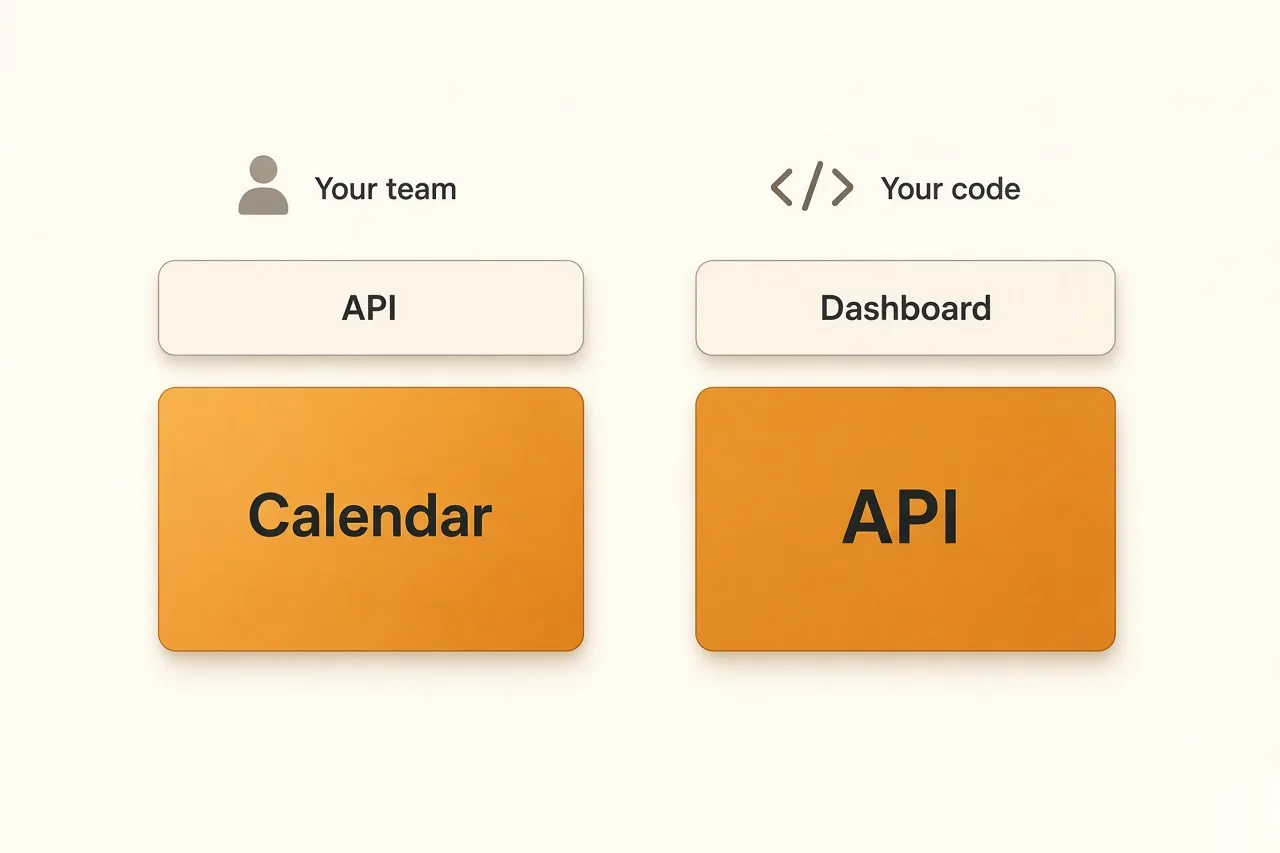
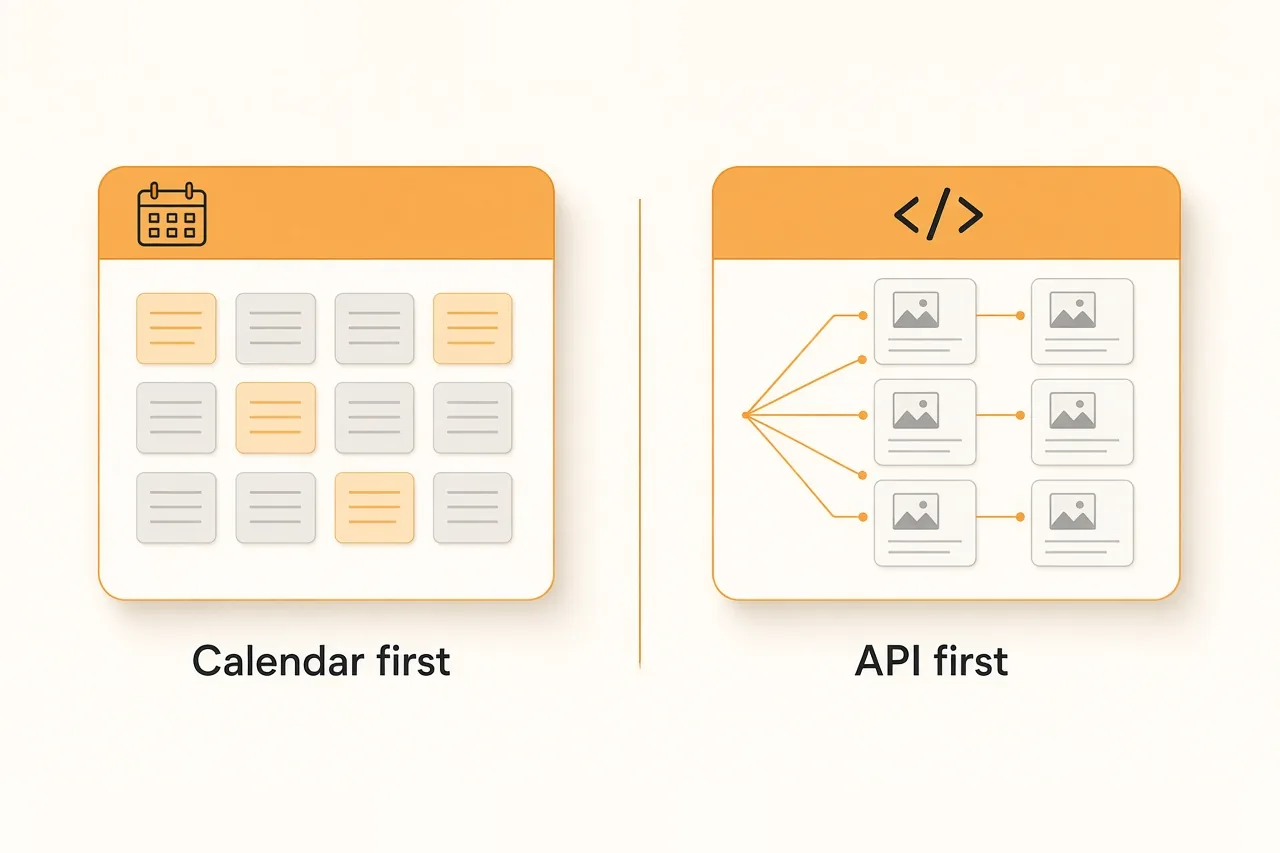
The emphasis is still different. Zernio calls itself "built for developers and teams with technical resources", and its docs, SDKs and MCP server get most of the attention. Postiz is the other way round: the calendar, composer and client previews come first, and the API is one feature among many.
My take: if a non-technical person will live in the tool every day, Postiz fits better. If code or an AI agent does most of the posting and a human checks in occasionally, Zernio's dashboard is enough.
Which one is cheaper for your number of accounts?
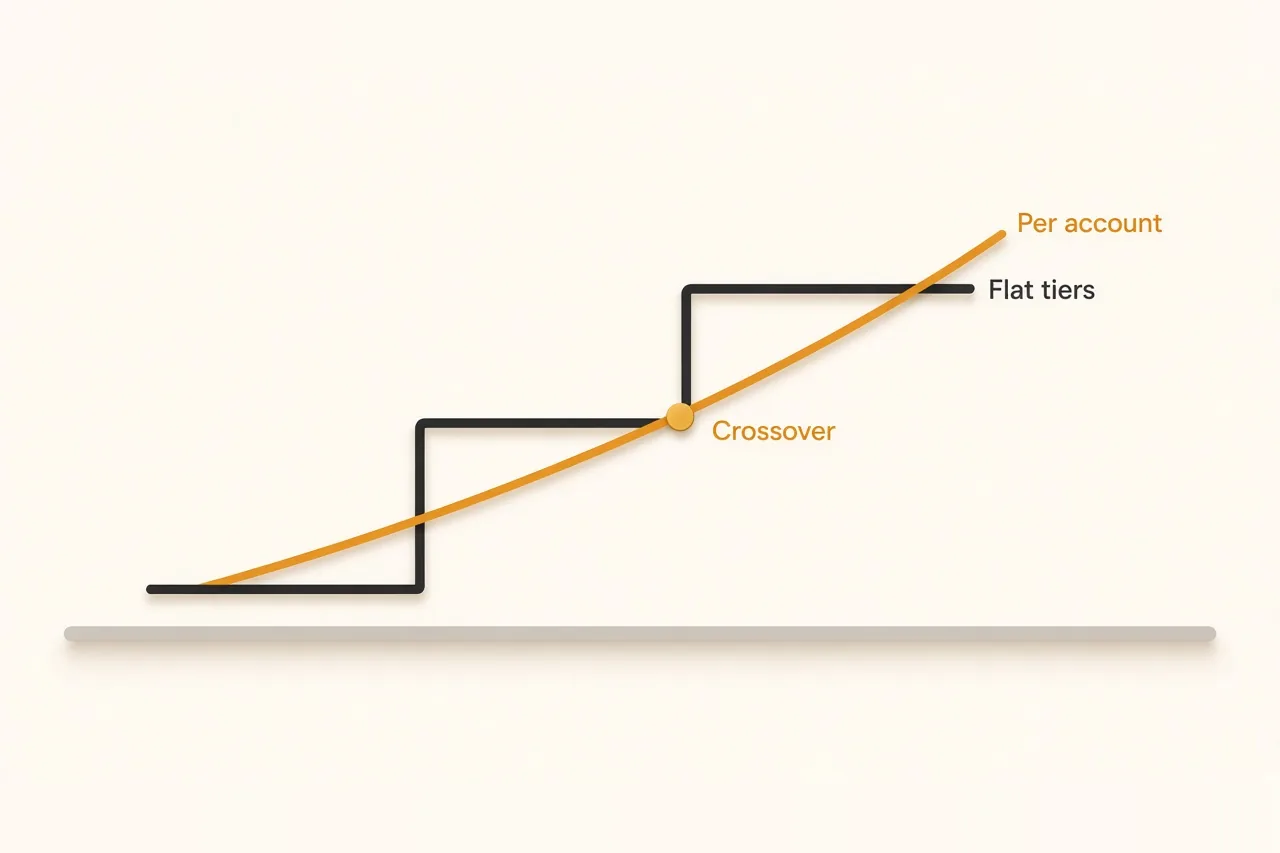
The two tools bill in completely different shapes. Postiz charges a flat fee per plan and caps your channels. Zernio charges per connected account, and each price band applies only to the accounts inside it.
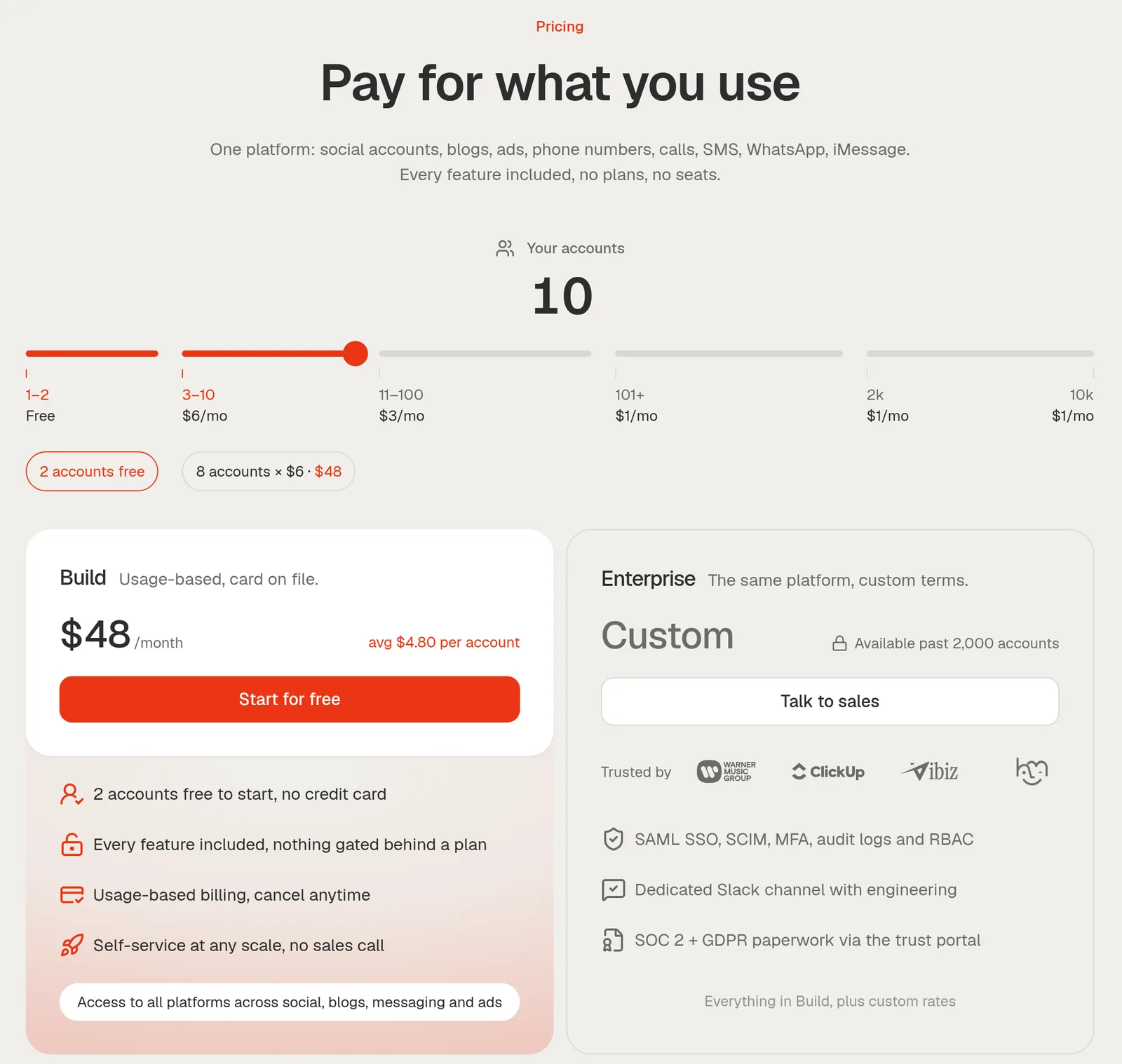
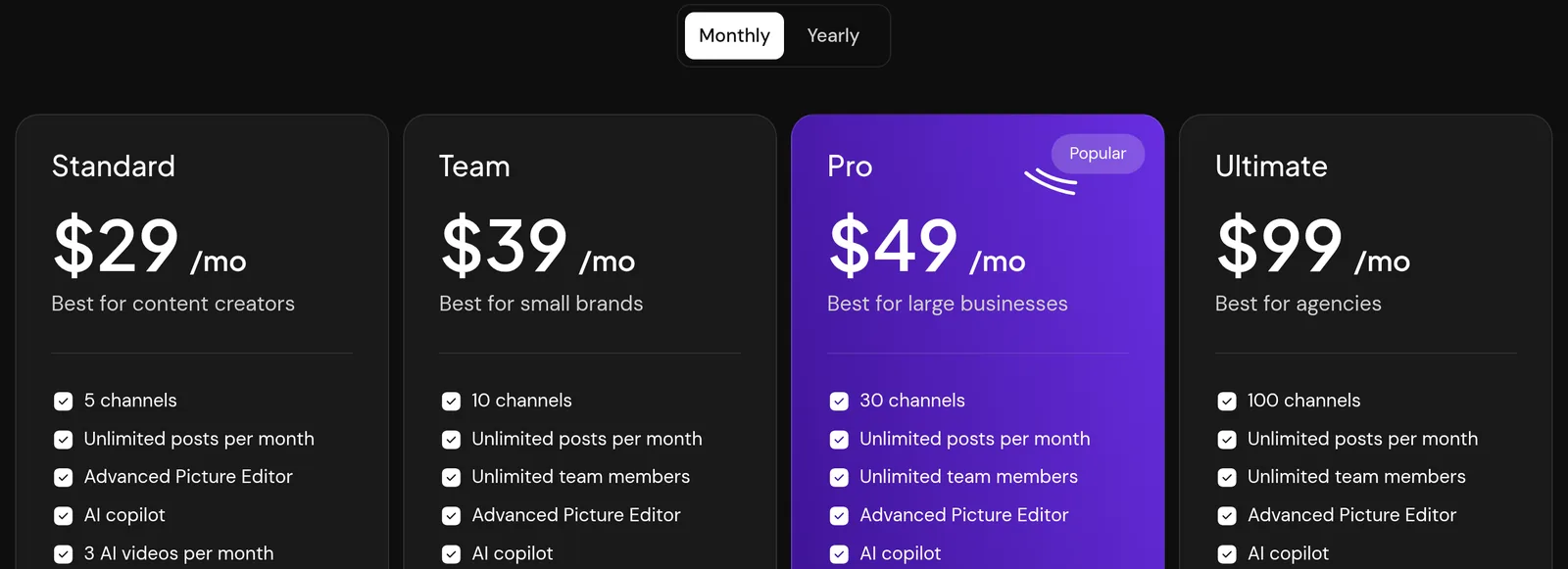
On Zernio, accounts 1 and 2 are free. Accounts 3 to 10 cost $6 each, 11 to 100 cost $3 each, and anything past 100 costs $1 each. Postiz Cloud is $29 for 5 channels, $39 for 10, $49 for 30 and $99 for 100, or $23, $31, $39 and $79 a month on annual billing.
Here's what that works out to. The maths is mine, on both companies' list prices.
| Connected accounts | Zernio | Postiz monthly | Postiz annual |
|---|---|---|---|
| 2 | $0 | $29 | $23 |
| 5 | $18 | $29 | $23 |
| 8 | $36 | $39 | $31 |
| 9 | $42 | $39 | $31 |
| 20 | $78 | $49 | $39 |
| 30 | $108 | $49 | $39 |
| 100 | $318 | $99 | $79 |
Zernio is cheaper up to 8 accounts against Postiz's monthly plans, and up to 7 against annual billing. Past that, Postiz Cloud wins, and the gap widens fast.
Two more things change the maths. Postiz's $29 Standard plan has no team members, so if anyone else touches the calendar, your real starting price is $39. Zernio's seats are unlimited at any size.
The other one hides in Zernio's rate card. X charges for its API per call, and Zernio passes that on at cost: $0.015 per post, and $0.200 per post that contains a URL. Thirty link posts to X in a month adds $6. Small, but it's a meter most comparisons never mention.
What does "free" mean on each tool?
Both tools say "free", and they mean different things.
Zernio's free tier is permanent for two connected accounts, with no card. You get the full API, unlimited posts, analytics and the inbox, capped at 60 API requests a minute. For one creator with Instagram and LinkedIn, that may be all you ever pay for.
Postiz Cloud has no free plan. Its docs say it plainly: without a subscription, the app is replaced by the plan picker. You get a 7-day trial, and starting it needs a card. Video clipping and some AI video generators stay locked until the trial converts.
The free version of Postiz is the self-hosted one. That's free in dollars and paid in time, which is the next question.
How hard is each one to set up?
On the cloud side, neither needs a server. Postiz Cloud has every platform's developer app registered already, so connecting most channels is a click and an OAuth screen. Zernio's flow is sign up, create a profile, connect accounts, then post from the dashboard or with an API key.
Connecting either one to an AI client takes one command. These are the Claude Code lines from each vendor's own setup page:
Both open a browser sign-in on first use, so there's no key to paste.
What does self-hosting Postiz cost you?
Postiz is the only one of the two you can run yourself. Zernio is hosted only; you can run its MCP server locally, but it still calls Zernio's cloud.
A self-hosted Postiz has no plan limits at all. Its docs say every install behaves like the top tier, so the channel cap and team seats stop mattering.
The bill arrives in other forms:
- A server with PostgreSQL, Redis and Temporal. Temporal has been required since v2.12.0.
- At least 2 vCPU and 2 GB of RAM; Postiz recommends 4 GB or more once several people use it.
- Your own developer app on every OAuth platform. Only ten platforms, like Bluesky, WordPress and Medium, skip this step.
- App reviews. Postiz says Facebook, Instagram, Threads and YouTube approvals usually take more than a month.
- Your own OpenAI and generator keys for the AI features, and community-only support.
By Postiz's own estimate, those app reviews are the slowest step on the list. It even sells approval help as an optional paid service.
It's the same trade I walked through for n8n cloud vs self-hosted: the software is free, the hours aren't. If you already run Docker on a small VPS, you have most of what Postiz needs. If you've never touched a server, the $29 plan is cheaper than your first lost Saturday.
If you do self-host, I'd put Postiz on Hostinger's KVM 2 VPS. It has 2 vCPU cores, 8 GB of RAM and 100 GB of NVMe storage, so it clears Postiz's 2 vCPU floor and doubles the 4 GB of RAM it suggests for teams.
| Hostinger plan | vCPU | RAM | NVMe storage | Intro price | Renews at |
|---|---|---|---|---|---|
| KVM 1 | 1 | 4 GB | 50 GB | $6.49/mo | $11.99/mo |
| KVM 2 | 2 | 8 GB | 100 GB | $8.99/mo | $14.99/mo |
| KVM 4 | 4 | 16 GB | 200 GB | $12.99/mo | $28.99/mo |
Prices are from Hostinger's VPS page on 28 September 2026, in US dollars. The intro price is paid upfront for the whole term.
Skip KVM 1: its single vCPU is below Postiz's minimum. KVM 4 matches Postiz's full recommended spec of 4 vCPU and 8 GB, so it's the upgrade if a large team shares one install. Even at KVM 2's $14.99 renewal price, the server costs about half of Postiz Cloud's $29 plan. The real cost is the developer-app work above.
Which platforms can each one post to?
Postiz covers more networks. Its docs list 34, including the usual big names plus Mastodon, Nostr, Farcaster, Lemmy, Twitch, Kick, VK, MeWe, Tumblr, Skool, Whop, and blog targets like Medium, Dev.to, Hashnode and WordPress.
Zernio lists 16 platforms: Instagram, TikTok, YouTube, X, LinkedIn, Facebook, Threads, Pinterest, Reddit, Bluesky, WhatsApp, Telegram, Discord, Snapchat, Google Business and Slack. It adds WordPress and Shopify through a separate Blogs API.
The big networks are on both lists. Postiz wins on the long tail of open and community platforms. Zernio wins on messaging (WhatsApp is the obvious one) and on paid ads across Meta, Google, TikTok, LinkedIn, Pinterest, X and OpenAI.
Both handle Instagram carousels. Zernio's limit is 10 items per carousel with no mixing of images and video, and Instagram accounts must be Business accounts.
One Zernio rule to know before you connect anything: each profile holds one account per platform. Connect a different Instagram account into an occupied slot and it replaces the old one, deleting that slot's analytics, inbox and DM history. Running several accounts on one platform means one profile each.
How do the API and MCP servers compare for AI agents?
This is where the two tools feel most different, and it matters most if an AI agent does your posting.
Both offer a hosted MCP server, so Claude, ChatGPT, Cursor or Claude Code can schedule posts for you. Both accept OAuth sign-in or an API key.
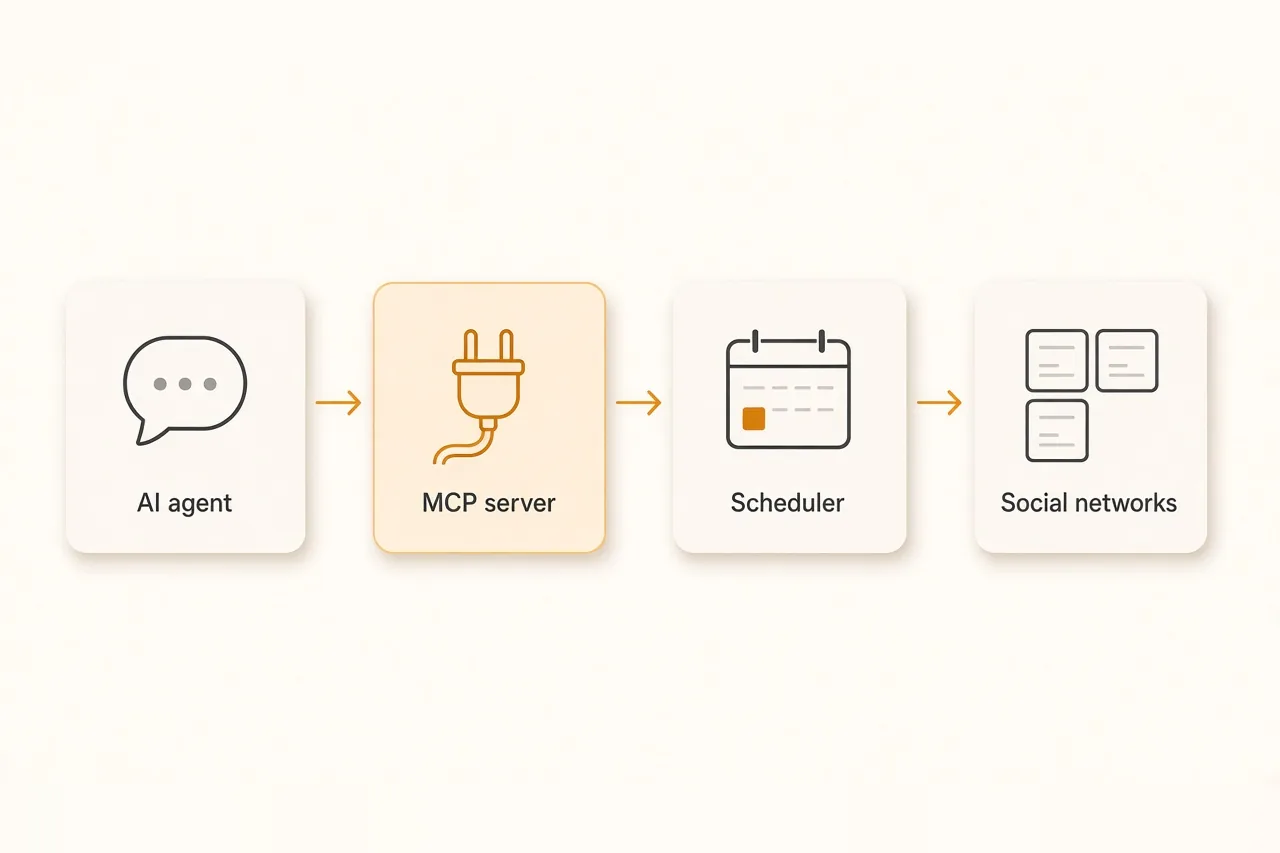
Postiz's MCP server exposes 13 tools. They cover the publishing job well: list channels, read posting rules, schedule or draft posts, generate images and video, and clip long YouTube videos. Its docs say the MCP tools can't read or reply to comments.
Zernio's server has 20 core tools, and the rest of its API loads on demand through a search tool. Its Claude page puts the total at 496 tools, from posting and queues to analytics, DMs and ads.
The API limits tell the same story. Postiz caps its create-post endpoint at 90 requests an hour, though one request can carry many posts. Zernio allows 60 requests a minute on the free tier and 600 once you connect a third account.
My take: for an agent that only schedules posts, both work. For an agent that also reads analytics, answers DMs or runs ads, Zernio has far more surface.
Which one has the better built-in AI?
Postiz, and it isn't close, because Zernio doesn't try.
Postiz Cloud includes an AI copilot for writing posts, an in-app agent you can chat with, AI video on every plan, and AI images from the $39 Team plan (100 a month). It also turns long YouTube videos into captioned vertical clips, starting at 60 minutes a month on Standard.
I found no content generator on Zernio's features or pricing pages. It moves content you've already made. That's fine if an agent or another tool already writes your captions: it writes, and Zernio publishes.
If you don't have an agent or a writing tool already, Postiz saves you a subscription.
How do analytics, inbox and comments compare?
Postiz reports analytics for 10 of its 34 platforms, including Instagram, Facebook Pages, LinkedIn Pages, TikTok, YouTube, Threads, Pinterest and X. LinkedIn numbers work for Pages only, because that's what LinkedIn's API exposes.
Zernio returns metrics for 11 platforms and adds a best-time-to-post endpoint. Its bigger difference is the inbox: reading and sending DMs, replying to comments and handling reviews, all included in the per-account price. The first 10,000 sent messages a month are free.
Postiz's docs have no unified inbox. You can schedule follow-up comments on your own posts, and set "plugs" that auto-repost or comment when a post passes a threshold.
If community management matters to you, Zernio does more of it.
Which is better for teams and client work?
Postiz has the more finished agency workflow. You get client groups, invite links that let a client connect an account without a login, and public preview links where clients can comment on a post before it goes out. Team roles run from User to Super Admin.
The catch is price. Team members start on the $39 plan, and approvals are a conversation, not a lock: nothing stops a post from publishing unless it's still a draft.
Zernio gives unlimited team members on every account, plus white-label OAuth so your own customers can connect their accounts inside your app. That makes it the pick for agencies building their own client portal, and the weaker pick for agencies that want an approval screen out of the box.
How do bulk uploads and queues work?
Zernio has the stronger bulk tools. You can upload hundreds of posts from a CSV, with a dry-run mode to catch errors first. Queue slots give each profile recurring posting times, and each new post drops into the next free slot.
Postiz uses per-channel time slots in a similar way, plus repeated posts for evergreen content and RSS auto-posting from the Team plan up. Its calendar has no multi-select, so bulk changes go through the list view or the API, which accepts many posts in one request.
Both send webhooks when posts publish, and both plug into n8n and Make. Postiz ships a custom n8n node for your n8n workflows, and Zernio publishes n8n templates and lists Zapier support too.
Where does each one fall short?
Postiz falls short in three places:
- No free cloud plan, and the cheapest plan has no team members or AI images.
- Self-hosting means server upkeep plus developer apps and app reviews on every major network.
- A tight 90-an-hour limit on API post creation, and no DM inbox in its docs.
Zernio has its own weak spots:
- Costs climb with every account, so past 8 accounts it's the pricier option.
- No self-hosting, so you depend on its uptime and its pricing decisions.
- No built-in AI writing, an extra meter for X, and a dashboard built for technical teams first.
Which should you choose?
Here's the question that decides it: how many accounts will you connect in the next year, and will a human or code do the posting?
Pick Zernio if:
- You'll connect 8 accounts or fewer, or you want two accounts free for good.
- An AI agent, n8n or your own app does the posting.
- You need DMs, comment replies or paid ads in the same place.
- You're building social posting into a product for your own customers.
Pick Postiz if:
- You'll connect 9 or more accounts; Postiz Cloud gets cheaper from there.
- A non-technical person plans the content calendar every day.
- You want built-in AI writing, images, video or clipping.
- You're happy to self-host and want no limits or subscription. A Hostinger KVM 2 VPS covers what it needs.
Skip both if you only post to two or three networks by hand once a week. The networks' own built-in scheduling may be all you need.
Zernio is my pick for an agent-driven setup like mine, and two accounts sit well below the crossover. If I were running social for ten or more clients with a human team, I'd take Postiz Cloud's Pro plan instead.
Frequently asked questions
If an agent or your own code does the posting and you're under nine accounts, start with Zernio's two free accounts. That's enough to run a real posting week before you pay anything.
If a team plans content by hand, or you're past the crossover, Postiz Cloud is the better deal, and the 7-day trial shows you the calendar before you pay.