Semrush's cheapest paid SEO plan tracks 500 keywords for $139 a month. SE Ranking's tracks 2,000 for $129.
That one line settles more of this comparison than any feature list. But it doesn't settle all of it, because Similarweb isn't playing the same game at all.
Most Semrush vs SE Ranking vs Similarweb pages line up three SEO suites and score them. That's the mistake. Two of these tools help you rank. The third tells you where a website's traffic comes from, and for an affiliate marketer that can be the more valuable answer.
So the real question isn't which tool is best. It's which job you're paying for. I've laid out the prices, limits and data sources for all three, and my pick by situation is at the end.
Some links here are affiliate links. They don't change your price or my verdict.
Semrush vs SE Ranking vs Similarweb at a glance
Semrush and SE Ranking are all-in-one SEO platforms: keyword research, rank tracking, site audits and backlink analysis. Similarweb is a web traffic intelligence platform that estimates how many visits any site gets and from which channels. If you're still building your stack, my roundup of the best SEO tools for bloggers and affiliate marketers shows where each one fits next to the free options.
| Semrush | SE Ranking | Similarweb | |
|---|---|---|---|
| Main job | All-in-one SEO + AI search | All-in-one SEO + AI search | Traffic and market intelligence |
| Entry plan, monthly | $139 (SEO) | $129 (Core) | $199 (Competitive Intelligence) |
| Entry plan, annual | $117.33 a month | $103.20 a month | $125 a month |
| Tracked keywords on entry plan | 500 a day | 2,000 a day | None (no rank tracker) |
| Sites or projects | 5 websites | 10 projects | Analyse any site |
| Users included | 1, extras from $45 | 1, extras from $16 | 1, no published extra-seat price |
| Free option | Free plan, 10 reports a day | 14-day trial, no card | 7-day trial with card, free sample data |
| Traffic estimates for any site | Yes, deeper in the $289 Traffic & Market add-on | Competitor SEO and PPC data | Yes, every channel |
| Affiliate traffic channel | Not listed | No | Yes, since April 2026 |
Prices are list prices in US dollars from each vendor's pricing page, as of 4 October 2026.
What job does each tool actually do?
Semrush and SE Ranking answer the same question: how do I rank higher on Google, and now in AI answers too? Both crawl the web, build their own keyword and backlink databases, track your positions every day and audit your site for technical problems.
Similarweb answers a different question: how much traffic does this site get, and where does it come from? It estimates visits, engagement and the split between search, direct, social, referrals, ads and more, for almost any site big enough to measure.
Similarweb does sell SEO features. Its $399 Competitive Intel & SEO & AEO plan adds keyword research, a rank tracker, a site audit and backlinks. But you pay for traffic intelligence first and get SEO on top, which is the reverse of the other two.
My take: compare Semrush with SE Ranking as SEO suites. Then decide separately whether you need Similarweb's traffic view, or whether Semrush's own traffic add-on covers it.
How much does each tool cost in 2026?
All three changed their plans recently, and many comparisons still quote the old ones. Here's what the pricing pages show now.
| Plan | Monthly billing | Annual billing (per month) | Key limits |
|---|---|---|---|
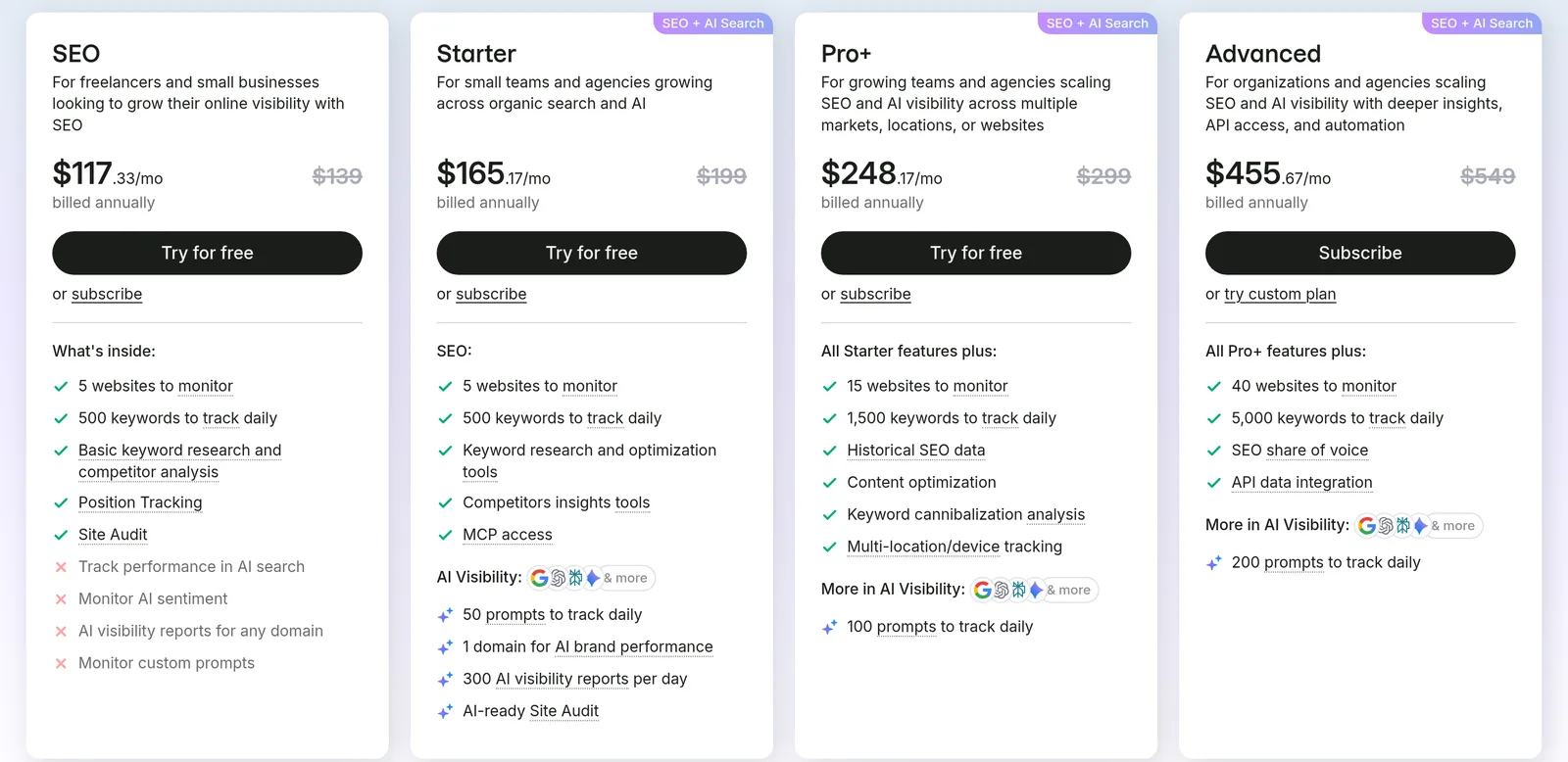
| Semrush SEO | $139 | $117.33 | 5 sites, 500 keywords, no AI tracking |
| Semrush Starter (SEO + AI Search) | $199 | $165.17 | 5 sites, 500 keywords, 50 AI prompts |
| Semrush Pro+ | $299 | $248.17 | 15 sites, 1,500 keywords, 100 AI prompts |
| SE Ranking Core | $129 | $103.20 | 10 projects, 2,000 keywords, 100 AI prompts |
| SE Ranking Growth | $279 | $223.20 | 30 projects, 5,000 keywords, 250 AI prompts |
| Similarweb Competitive Intelligence | $199 | $125 | 1 user, 3 months of history |
| Similarweb Competitive Intel & SEO & AEO | $399 | $333 | 1 user, 6 months of history, 150 AI prompts |
Semrush's annual discount is up to 17%, SE Ranking's is 20%, and Similarweb's is the biggest on its entry plan: $125 instead of $199. On all three, annual plans are paid upfront.
What does a full year cost?
Here's the arithmetic for one person on each entry plan. The maths is mine, on the list prices above.
| Entry plan for a year | Paying monthly | Paying annually |
|---|---|---|
| Semrush SEO | $1,668 | $1,407.96 |
| SE Ranking Core | $1,548 | $1,238.40 |
| Similarweb Competitive Intelligence | $2,388 | $1,500 |
The gap between Semrush and SE Ranking is about $170 a year on annual billing. That's small. The real difference shows up in what each plan lets you track, which is the next section.
Which gives you more for the money on rank tracking?
SE Ranking, by a wide margin.
At list price, Semrush's SEO plan works out to $27.80 for every 100 keywords you track. SE Ranking Core works out to $6.45. To track more than 500 keywords on Semrush you move to Pro+ at $299, and that gets you 1,500. SE Ranking Core already gives you 2,000 for $129.
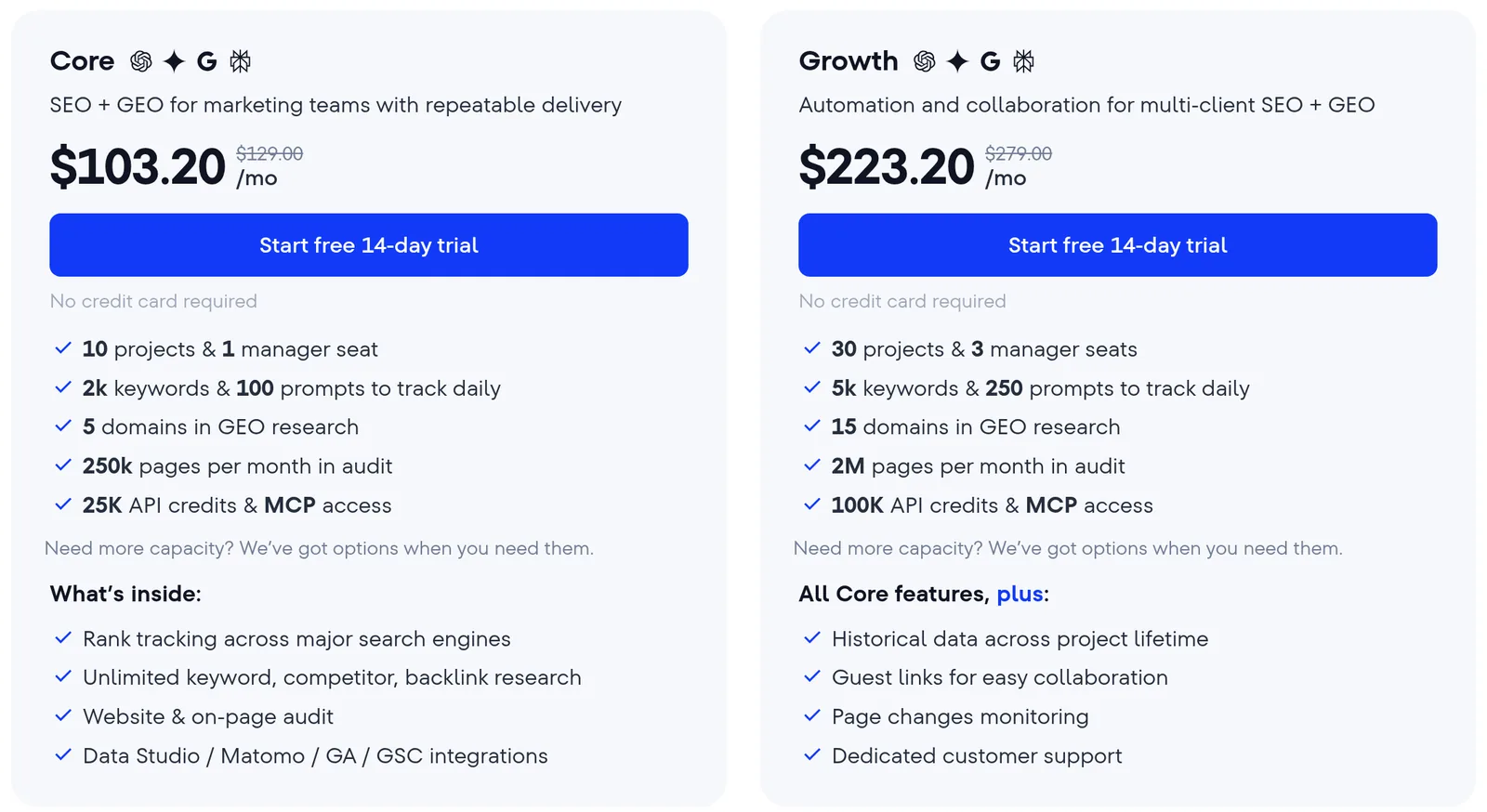
Projects tell the same story. Semrush's two cheapest plans monitor 5 websites. SE Ranking Core allows 10 projects. If you run a few niche sites, that difference decides it before you open either dashboard.
Here's the catch with SE Ranking: one login allows one active session. Its FAQ says that if someone else signs in, you're prompted to hand off the session.
Want a writer or VA in there too? Budget for an extra seat, from $16 a month on SE Ranking. On Semrush, extra users start at $45.
Semrush keeps an edge on depth. Historical SEO data, content optimization and keyword cannibalization analysis sit on Pro+ and above, so the entry plan is deliberately thin.
Whose data should you trust?
Each tool collects data differently, and that shapes what it's good at.
Semrush says its database holds 28.8 billion keywords across 142 country databases and 43 trillion backlinks, fed by a crawler that scans about 10 billion pages a day. SE Ranking says it covers over 5 billion keywords across 188 locations. Bigger numbers matter most for long-tail keywords in large markets. For a niche blog in one country, both cover the keywords you'll target.
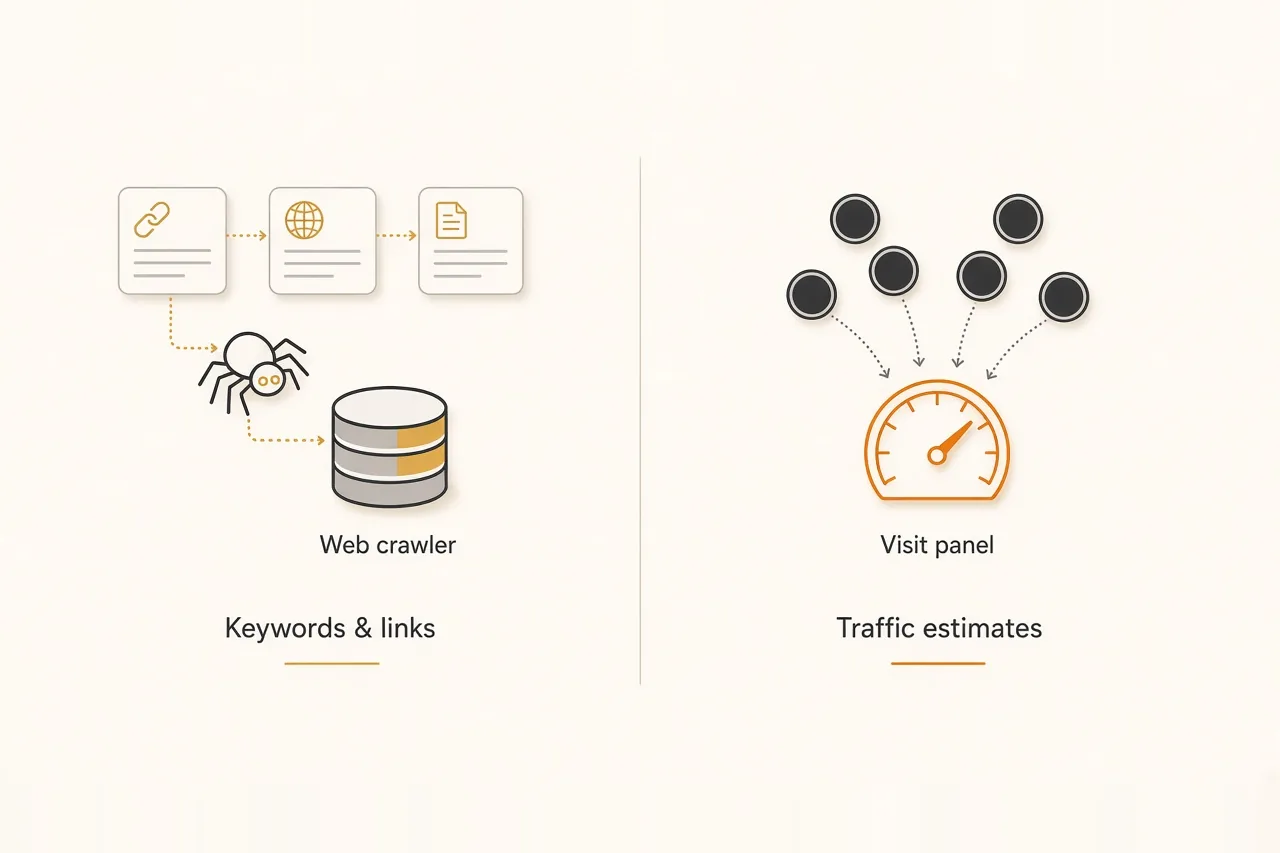
Similarweb works the other way. It blends an anonymous panel of device data from its own consumer products, first-party analytics that sites connect directly, partner data and public web data, then models traffic with machine learning. That's why it can split traffic by channel, which a crawler can't do.
The limit is size. Similarweb says a site needs enough traffic before it can produce estimates. If you're studying small niche blogs, you may find thin data or none. Its monthly data lands by the 10th of the following month.
Treat every number from all three as an estimate. None of them sees your competitor's real analytics. They're good for comparing sites against each other, and weak as exact counts.
Which is better for keyword and competitor research?
For finding keywords to write about, Semrush and SE Ranking both do the job. SE Ranking's Core plan lists unlimited keyword, competitor and backlink research. Semrush's SEO plan describes its research tools as basic, with the fuller keyword and optimization tools starting on the $199 Starter plan.
For a blogger, the workflow is the same on both. Enter a competitor's domain, pull the keywords it ranks for, filter for ones you can realistically win, and track them.
Whichever tool you pick, the method matters more than the data source. My keyword research guide for bloggers covers how to read search intent, judge difficulty and group keywords into posts.
Similarweb's keyword research only comes with the $399 plan. Paying that much for keyword research alone makes little sense when SE Ranking's whole suite costs $129.
My take: if keyword and competitor research is the main job, start with SE Ranking. Pick Semrush when you'll use the higher plans' extras, like content optimization and historical data.
Which is better for affiliate marketers?
This is where Similarweb earns its place.
In April 2026 Similarweb added Affiliates as its own traffic channel, next to Referrals, Gen AI, paid social and the rest. Its help centre describes it as traffic from partners earning commissions through performance-based deals. Before you join a program, you can see how much of a merchant's traffic comes from affiliates at all.
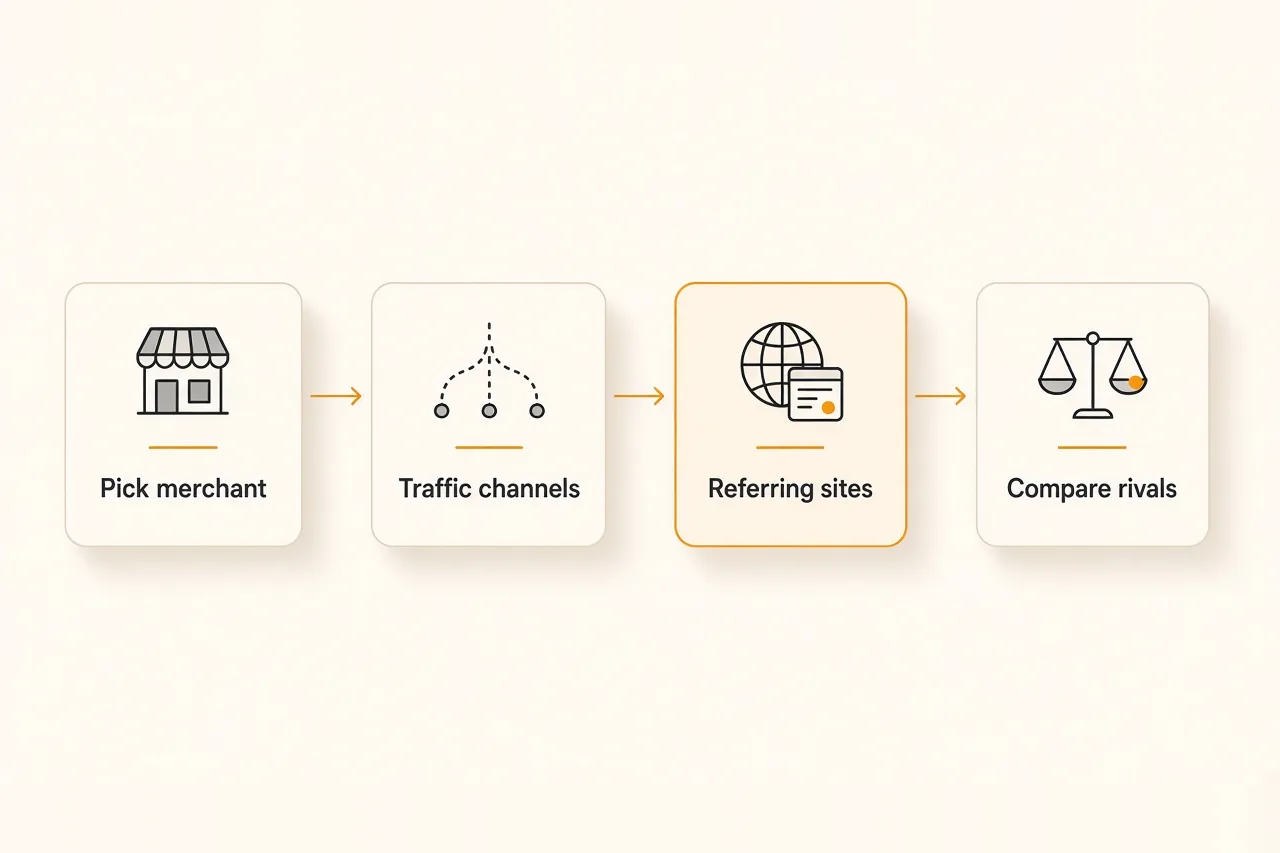
Its Marketing Channels report also has a Traffic Sources view that lists the individual sites sending traffic. That's how you find the review sites and blogs already winning a program, then study them in Semrush or SE Ranking.
Semrush and SE Ranking give you the other half. They show which keywords those affiliate sites rank for and which pages bring in their organic traffic. That's the content you'd need to write to compete.
The cheapest serious setup for affiliate research is two tools: SE Ranking Core for keywords and tracking, plus Similarweb's Competitive Intelligence plan for traffic channels. On annual billing that's $228.20 a month combined.
Does Semrush's Traffic & Market toolkit replace Similarweb?
Partly, and it's the comparison most posts skip.
Semrush sells a separate Traffic & Market toolkit at $289 a month billed annually. It covers traffic overview, acquisition channel mix, top pages and competitor alerts, for up to 100 competitors across 190+ countries, with history back to 2017. It's one seat, and each extra seat starts at $289.
Stack it on Semrush's SEO plan and a year costs $4,875.96 on annual billing. Similarweb's $333 plan, which bundles traffic intelligence with its SEO tools, costs $3,996 a year. SE Ranking Core plus Similarweb's entry plan comes to $2,738.40.
Choose the Semrush bundle if you want one login and already live in Semrush. Choose Similarweb if traffic intelligence is the main job, or if you need the Affiliates channel, which Semrush's Traffic & Market pricing page doesn't list.
What do the add-ons cost?
The plan price is rarely the final bill. Here's what each vendor charges to go past the base limits.
| Add-on | Semrush | SE Ranking | Similarweb |
|---|---|---|---|
| Extra user | From $45 a month | From $16 a month | Not published for self-serve plans |
| More tracked keywords | Move up a plan | From $22.40 a month on Core | Not applicable |
| Traffic intelligence | $289 a month, billed annually | Not offered | Included |
| White-label reports | Pro Report, $20 a month per report | Agency Pack, $69 a month, annual only | Not published |
| API access | Advanced plan ($549) and up | API credits included; extra API pack from $45 a month | Business packages, via sales |
Semrush's Base Report add-on, at $10 a month per report, pulls in Google Analytics and Search Console data too. SE Ranking also sells an AI Search add-on at $89 a month, or $71.20 billed annually, for 200 extra prompts.
The pattern: SE Ranking's extras are cheap and granular. Semrush's are pricier but deeper. Similarweb's self-serve plans are what they are, and anything bigger goes through sales.
What about tracking AI search visibility?
All three now track how brands appear in AI answers, and they bundle it differently.
Semrush's pricing page marks AI search tracking as not included on the $139 SEO plan. AI visibility starts on the $199 Starter plan, with 50 prompts tracked a day. SE Ranking Core tracks 100 prompts a day across five AI models. Similarweb's $399 plan includes 150 tracked prompts plus sentiment and citation analysis.
If AI visibility is a priority on a small budget, SE Ranking Core gives you the most prompts for the least money.
What can you test for free before paying?
| Semrush | SE Ranking | Similarweb | |
|---|---|---|---|
| Free plan | Yes: 1 demo project, 10 reports a day | No | Free high-level data on similarweb.com |
| Free trial | 7 days | 14 days | 7 days |
| Card needed for trial | Not stated on the pricing page | No card required | Yes, billed when the trial ends |
| Trial limits | No data exports | 750 tracked keywords, 20 prompts a day | Self-serve plan features |
SE Ranking's trial is the most generous: twice as long and no card. Semrush disables exports during its trial, so plan your test around on-screen reports. Similarweb bills automatically when its 7 days end, so set a reminder before you start.
Where does each one fall short?
Semrush:
- The $139 SEO plan is thin: 500 keywords, 5 sites, basic research tools and no AI search tracking.
- Extra users cost $45 or more each, and the traffic add-on is another $289.
- No data exports during the free trial.
SE Ranking:
- One active session per login, so sharing an account doesn't work.
- Smaller keyword and backlink databases than Semrush's, by SE Ranking's own figures.
- Its pricing page now starts at $129 a month, so there's no budget entry tier.
Similarweb:
- Not an SEO suite on its entry plan: no rank tracking, no site audit.
- Thin or missing data for small sites, and only 3 months of history on the cheapest plan.
- Single user on every self-serve plan, and a trial that bills automatically.
Which should you choose?
Start with one question: are you trying to rank pages, or trying to understand where a market's traffic goes?
Pick SE Ranking if:
- You run one to ten blogs or niche sites and want the most tracked keywords per dollar.
- You're watching cost: $103.20 a month on annual billing gets you the full suite.
- You want to automate reports through its API and MCP access. It lists n8n and Make support, so its data can feed n8n workflows for automated reports.
Pick Semrush if:
- You need the biggest keyword and backlink databases, especially for long-tail research in large markets.
- You'll pay for Pro+ or higher to get historical data, content optimization and cannibalization checks.
- You want SEO and traffic analytics under one login and can afford the $289 add-on.
Pick Similarweb if:
- You're an affiliate marketer choosing programs and want to see affiliate and referral traffic.
- You research markets, partners or acquisitions more than you write posts.
- You already have an SEO tool and only need the traffic view.
Skip all three if your site is new and gets little traffic. Google Search Console shows your real queries for free, and a site audit won't fix a site Google hasn't found yet. My WordPress performance checklist is a better use of your first month.
For most bloggers, SE Ranking is my pick: it does the core SEO jobs at the lowest price, with four times Semrush's entry-plan keywords. Affiliate marketers should add Similarweb's entry plan when picking programs. Semrush makes sense once you're ready for its higher tiers.
Frequently asked questions
If you're a blogger choosing one SEO suite, start SE Ranking's 14-day trial. It doesn't need a card, and two weeks is enough to set up tracking for the keywords you care about.
If you pick affiliate programs for a living, Similarweb's affiliate channel answers the question the SEO tools can't: is this merchant's affiliate traffic worth chasing?