Multi-accounting means one person or business running more than one account on the same platform. On eBay, Etsy, Reddit and TikTok that's openly allowed. On Facebook and LinkedIn, the terms say one personal account per person. Amazon sits in between: one seller account per region, unless you have a legitimate business need.
So "is multi-accounting allowed?" has no single answer. It depends on the platform, and on why you want the second account.
Here's the part the tool vendors don't put on their landing pages: almost every platform draws its line in the same place, and no browser or proxy moves that line. This guide puts the actual rules side by side, shows how agencies get access without extra accounts, and explains where anti-detect browsers and proxies fit.
Every rule below comes from the platforms' own terms and help pages. This is a plain-English summary, not legal advice. Some links here are affiliate links. They don't change your price.

What is multi-accounting, in plain English?
Multi-accounting is operating two or more accounts on one service, either yourself or on behalf of a business. A seller with two Etsy shops is multi-accounting. So is a freelancer with a personal X account and a separate brand account. So is someone who opens a fresh ad account after the first one was suspended.
Those three cases are treated very differently. The first two are allowed by the platform's own help pages. The third breaks the rules almost everywhere.
The term also gets used for the tooling around it. When a vendor says "multi-accounting software", it usually means a browser that keeps each account's cookies, IP and device signals apart, so the platform can't trivially connect them. That only makes sense once you know how browser fingerprinting works, because device signals are how platforms link accounts even after you clear your cookies.
Is multi-accounting legal or just against the rules?
For most people, the question isn't criminal law. It's contract. When you sign up, you agree to the platform's terms. Breaking them usually means the platform can restrict, suspend or close your accounts, and sometimes hold back money in a seller account.
Things change when multiple accounts are used for fraud, scams, fake reviews or impersonation. Then other laws can apply, depending on where you are and what was done. I'm not a lawyer, and the rules vary by country, so if a lot of money or a client contract depends on it, get advice from someone qualified for your situation.
What I can do is show you what each platform's terms actually say. That's where nearly all the real risk sits.
What do the big platforms allow?
Here is the short version, from each platform's own pages, as of 28 October 2026.
| Platform | Multiple accounts? | The condition | What gets you in trouble |
|---|---|---|---|
| One personal account per person | Use Pages and business tools for brands | A second personal account; sharing your login | |
| Yes, as extra profiles | Up to 10 accounts logged in at once | Breaking the community rules on any of them | |
| Google Ads | Yes, with care | Each account tied to a real business and payment method | New accounts after a suspension; spreading violations across accounts |
| Amazon (sellers) | One per region by default | A second needs a legitimate business need | A second account without one; one bad account can affect all |
| eBay | Yes | Every account meets buyer and seller standards | Using another account to avoid limits or restrictions |
| Etsy | Yes, one shop per account | Separate email; list all your shops in each profile | Breaking the Seller Policy on any shop |
| TikTok | Yes | Not to deceive others or break the rules | A new account to get around a ban |
| X | Up to 10 accounts | Different, non-duplicative purposes | Accounts boosting each other; ban evasion |
| Yes, even with the same email | No voting on the same content from several accounts | Vote manipulation; ban evasion | |
| One account per person | Real name, your own profile | Profiles for others; sharing logins or cookies |
Facebook and Instagram
Meta's Terms of Service ask you to "create only one account (your own) and use it for personal purposes", and not to share your password or give others access. Facebook's help page is blunt: it's against the Community Standards to maintain more than one personal account.
The business route is different. Your personal account creates and manages a Page, and Meta's business tools handle the rest. Instagram is more relaxed: its help centre lets you add extra profiles and keep up to 10 accounts logged in at once.
Google Ads
Google Ads doesn't ban multiple accounts. It even offers manager accounts for agencies that run many. What it bans is using accounts to get around enforcement. Its Circumventing systems policy lists "creating new accounts to re-enter the system" after a suspension, and "spreading ads that violate Google Ads' policies across 2 or more accounts".
The penalty is harsh. Google calls these violations egregious and says accounts are suspended on detection, without prior warning. Its own best practices for multiple accounts: avoid bulk account creation, connect each account to a real business, and use a trusted payment method on each.
Amazon
Amazon's Seller Code of Conduct says one Seller Central account per region where you sell, unless you have a legitimate business need for a second, and every account is in good standing. Amazon's examples of a legitimate need: you own separate businesses for different brands, you make products for two distinct companies, or an Amazon program requires a separate account.
Here's the catch: if any one of your accounts isn't in good standing, Amazon says it may deactivate all of your selling accounts.
eBay and Etsy
Both marketplaces say yes. eBay's policy says "users may have multiple accounts", such as one for buying and one for selling, or separate product lines. Etsy says you're "welcome to run multiple shops", with one shop and one email per account.
Both tie the accounts together anyway. eBay says restrictions on one account may be applied to your linked accounts. Etsy asks you to list every shop you run in each account's public profile, and to use the same taxpayer ID and address where applicable.
TikTok, X and Reddit
The social platforms allow multiple accounts with different purposes. TikTok's guidelines say you can have multiple accounts, "but not to deceive others or break the rules". X allows up to ten accounts "for different, non-duplicative purposes". Reddit says you're "more than welcome" to create several accounts, even with the same email.
All three draw the same line: no accounts that boost each other, and no new account to get around a ban.
LinkedIn is the strictest. Its User Agreement says you'll "only have one LinkedIn account, which must be in your real name", and lists creating a profile for anyone other than yourself, or using someone else's account by "sharing log-in credentials or copying cookies", as things you agree not to do.
For brands, LinkedIn uses Pages, with admin roles you grant to real people.
Where does every platform draw the line?
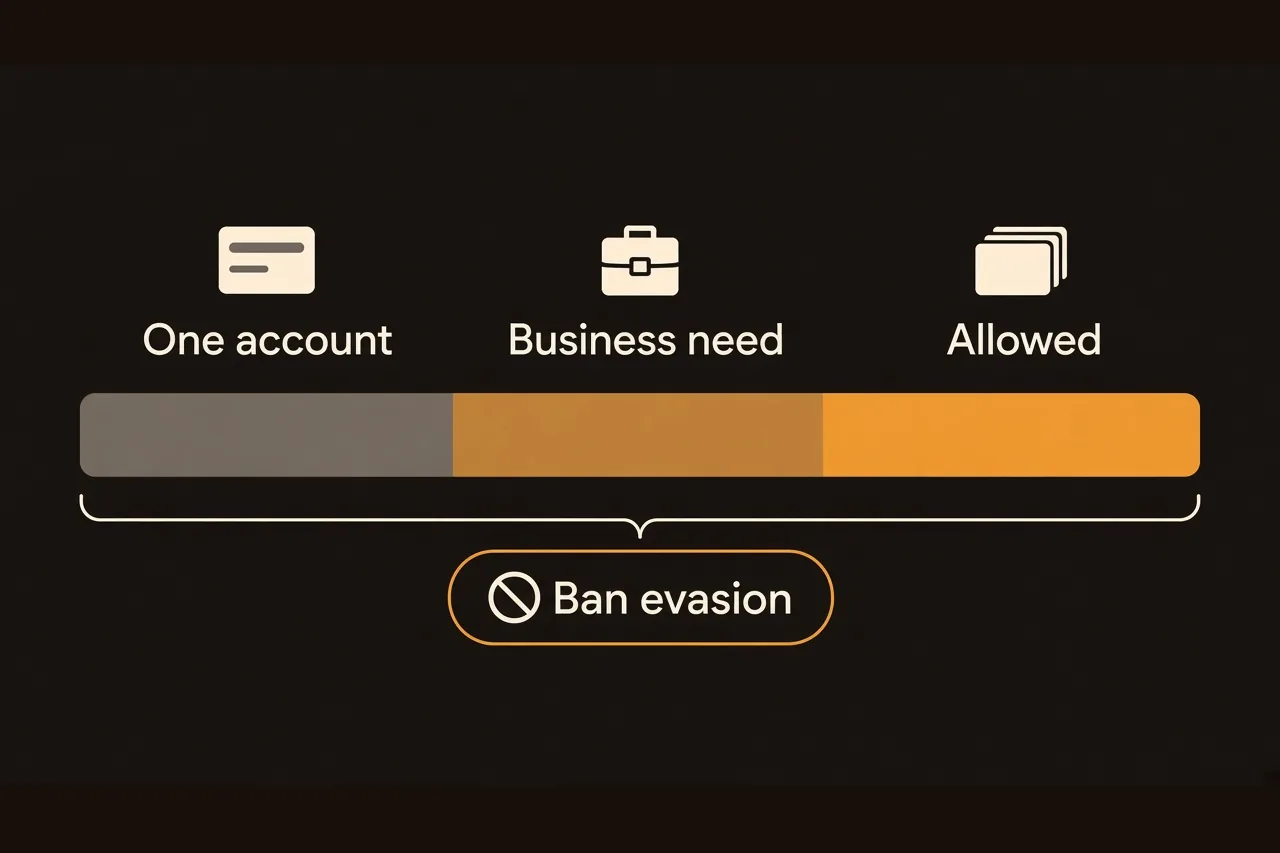
Read the policies side by side and the same four things show up as prohibited, even on platforms that welcome multiple accounts.
- Ban evasion: a new or repurposed account after a suspension or ban. This is the single most common reason multiple accounts are named in a policy.
- Manipulation: several accounts voting, liking, reviewing or posting the same thing to inflate it.
- False identity: accounts for people who don't exist, or for someone else, where the platform requires a real identity.
- Bulk creation: opening many accounts in a short time, which Google Ads and X both call out.
My take: if you'd be uncomfortable explaining to the platform why the second account exists, that's your answer. Google Ads even tells suspended advertisers to "provide details about why you have multiple accounts" in their appeal. A separate shop for a separate brand is an easy explanation. "My first account got banned" is not.
How do agencies manage client accounts legitimately?
This is where most agency multi-accounting problems disappear. The big ad and social platforms already have an official way for one team to work on many clients' accounts, without anyone logging in as the client.
| Platform | Official tool | How it works |
|---|---|---|
| Meta | Business portfolio partners | The client shares Pages or ad accounts with the agency's business portfolio, with full control or task-level access |
| Google Ads | Manager account (MCC) | One sign-in to view and manage linked client accounts, with different access levels for users |
| Page admin roles | Super admin, content admin, analyst, plus paid media roles for ads |
On Meta, the client keeps ownership. They add the agency as a partner using the agency's business portfolio ID, then choose which assets and tasks to share. Meta asks you to turn on two-factor authentication first, and a partner with full control still can't re-share the asset with another business.
Google's manager account works as an umbrella. It's a separate Google Ads account that links to client accounts, so the agency gets one dashboard and the client keeps its own sign-in details.
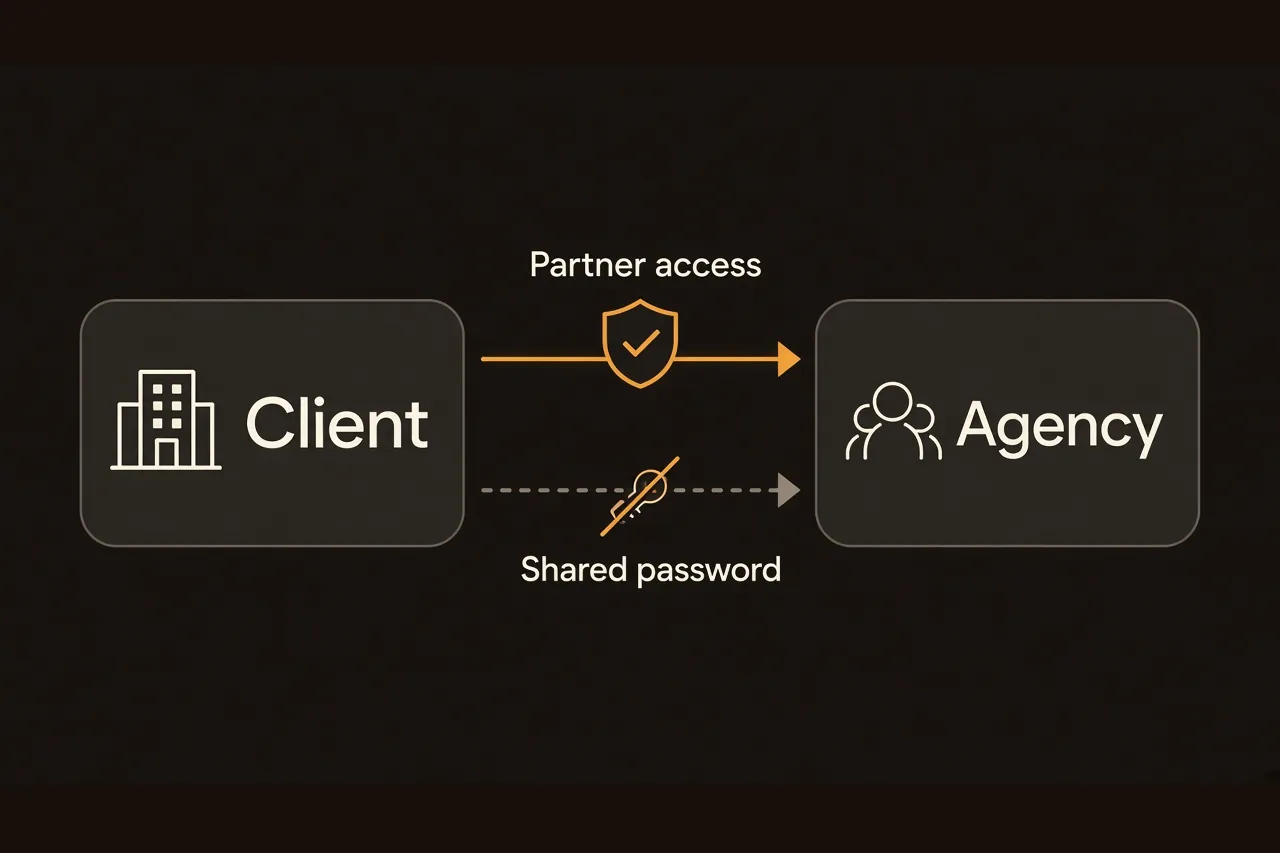
Why bother, when sharing a password is faster? Because Facebook's terms say not to give others access to your account, and LinkedIn's say not to share logins or copy cookies. Partner access avoids that, leaves a record of who did what, and lets the client remove you in one click when the contract ends.
If you're an agency, use these tools first. Only reach for anything else when a platform genuinely has no official access model.
Where do anti-detect browsers and proxies fit?
An anti-detect browser runs many separate browser profiles from one app. GoLogin's docs describe each profile as "like a separate laptop" with its own fingerprint, IP address through a proxy, cookies and extensions. Multilogin, GoLogin and AdsPower all work this way, and most add team sharing so staff can open a profile without seeing its password.
The proxy is the other half. Each profile gets its own IP, so two accounts don't share one connection. For accounts you log in to every day, a stable address usually beats a new one on every request, which is why people pick sticky sessions instead of rotating ones or a static ISP proxy per profile.
A VPN can't do this job, because it gives every account the same exit; my proxy vs VPN explainer covers why.
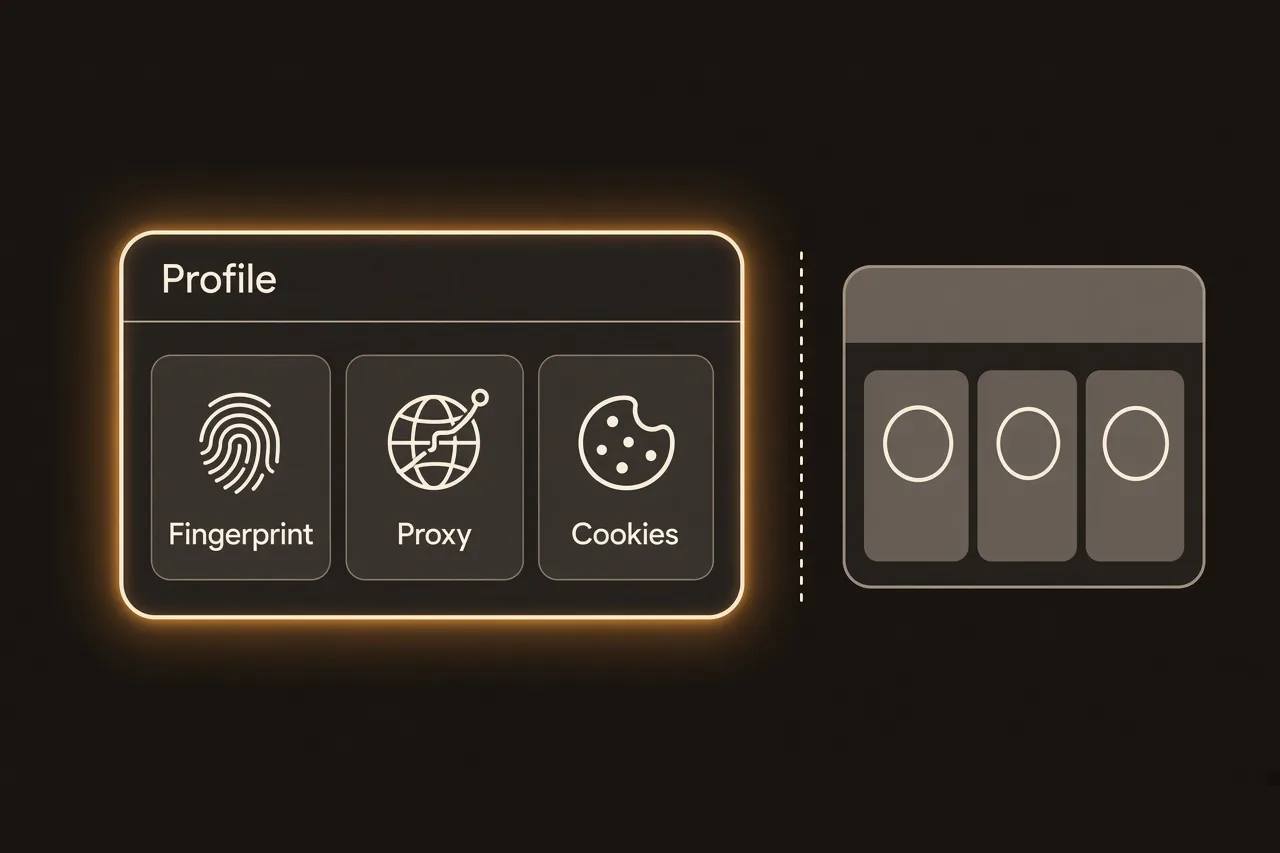
Used within the rules, this setup solves real problems:
- An Etsy seller with two shops stops signing in and out, which Etsy's own help page hints at when it suggests a different browser per account.
- A social media manager keeps each client's sessions apart, so a wrong post from the wrong account becomes far less likely.
- A team shares access to a profile without passing passwords around in chat.
- A QA or ad verification team checks what a page looks like from a clean profile in another country.
If you're comparing tools, my comparison of anti-detect browsers covers what each one costs and who it suits.
What can no tool guarantee?
Vendors sell these browsers with lines like "no linking" and "no unexpected bans". Read the platform policies and you'll see why that can't be a promise.
Platforms don't only look at your browser. Google says it may review your ads, website, accounts and third-party sources. eBay applies restrictions across linked accounts, and Etsy asks for the same taxpayer ID across your shops.
A perfect fingerprint does nothing about a shared bank account, a shared address or the same product listings.
There's a bigger point too. A tool changes how visible a link is. It doesn't change whether the account is allowed.
A second Facebook personal account is still against the terms, however clean its fingerprint. And if the reason for the account is ban evasion, hiding it better only raises the cost when it's found: Google says those suspensions come without warning and you won't be allowed to advertise again.
Leaks still happen on the technical side as well. A profile with a mismatched timezone or an exposed WebRTC address undoes the separation, so check for WebRTC, canvas and timezone leaks before you trust a setup.
What should you check before you open a second account?
Run through this before you create anything:
- Read the platform's current multiple-account rule. Policies change, and this table is dated 28 October 2026.
- Write down the reason in one sentence. "Separate brand" or "separate client" is a reason. "Previous account suspended" is not.
- Check whether an official tool already solves it: Meta partners, Google Ads manager accounts, LinkedIn Page roles, Instagram profiles.
- Keep every account in good standing. On Amazon and eBay, one bad account can drag the others down.
- Use real business details. Google Ads and Amazon both expect each account to map to a real business.
- Never share passwords with staff or clients. Use partner access, or a tool with team sharing.
- If you use an anti-detect browser, give each profile one stable proxy and test it before logging in.
- If contracts or significant money depend on it, ask a qualified lawyer, not a forum.
Frequently asked questions
Multi-accounting isn't one thing. It's ten different rulebooks that agree on one point: separate, honest accounts are often fine, and accounts used to dodge an enforcement never are. Start with the platform's own rule, use the official agency tools where they exist, and treat browsers and proxies as organisation, not as a loophole.
If the tooling side is new to you, the fingerprinting basics are the best place to start.